A History of Assamese Font Encoding: From Typewriter to Unicode
The complete history of Assamese font encoding systems — from mechanical typewriter fonts through Geetanjali, Ramdhenu, Bikash, and Pragjyotish, to Unicode standardization — and why the fragmentation happened.
The Typewriter Era: 1940s–1980s
Assamese type began as a physical technology. The first Assamese typewriters, introduced in the early 20th century, used mechanical type slugs arranged around a rotating drum. Each key pressed a slug against an inked ribbon, striking the paper and leaving an impression of the character.
Typewriter-era Assamese type is notable for two characteristics. First, conjunct characters were limited — the physical constraints of the typewriter mechanism could not accommodate the full repertoire of Assamese Juktakkhor. Writers and publishers developed conventions for representing conjuncts approximately. Second, the Shirorekha (top bar) was often applied as a separate key strike after the main character body, a physical workflow that created alignment inconsistencies across the typed line.
This typewriter encoding was never formalized. Each manufacturer’s machine had slightly different character selections and key positions. Documents from the typewriter era cannot be systematically converted to any digital encoding — they require manual transcription.
The PC Era Begins: The First Digital Fonts (Late 1980s–Early 1990s)
When personal computers arrived in India in the late 1980s and early 1990s, word processing and DTP became commercially viable for Assamese publishers. The challenge: computers at the time operated on ASCII (or DOS code pages) for Western languages, with no mechanism for encoding non-Latin scripts.
The solution adopted by early Assamese software developers was elegant in its simplicity and catastrophic in its long-term consequences: create a font file where the Assamese glyphs are mapped to the ASCII character positions. Type k and the font displays ক. The computer stores ASCII; the font provides the Assamese appearance.
This was the birth of the legacy encoding paradigm. Several developers and companies in Assam, Guwahati, and Kolkata created competing font systems simultaneously in the early 1990s, with no coordination.
The Timeline of Assamese Font Encoding Systems
| Period | System | Origin | Key Characteristics |
|---|---|---|---|
| Late 1980s | First PC fonts (unnamed) | Individual developers | Inconsistent mappings, limited conjunct support |
| Early 1990s | Geetanjali | Guwahati commercial software | Widespread adoption in Assam; became near-standard in newspaper DTP |
| Early 1990s | Ramdhenu | Independent developer | Different vowel matra mappings; popular in certain districts and printing houses |
| Mid-1990s | Bikash | Commercial font vendor | Targeted at book publishers; additional conjunct coverage |
| Mid-to-late 1990s | Pragjyotish | Regional developer | Named after the historical kingdom of Assam; used in specific institutional contexts |
| 1991 | ISCII standard published | Bureau of Indian Standards | Machine-readable Indian script encoding; not widely adopted in DTP |
| Late 1990s | Unicode 2.0 Bangla/Assamese block | Unicode Consortium | U+0980–U+09FF; includes Assamese-specific characters U+09F0, U+09F1 |
| Early 2000s | Unicode adoption begins | Newspapers, government | Gradual shift; dual-encoding workflows begin |
| 2010s | Smartphone acceleration | Mobile platforms | Android/iOS force Unicode; Unicode becomes dominant for digital text |
| 2020s | Legacy DTP still active | Printing houses | Geetanjali and Ramdhenu still in production use at many publishers |
The Fragmentation Problem
The root cause of fragmentation was economic, not technical. Each developer created a keyboard layout optimized for their assessment of the most efficient Assamese typing experience, without any obligation to match competitors. Customers purchased complete packages — hardware, software, fonts — from a single vendor, creating ecosystem lock-in.
By the mid-1990s, a significant fraction of Assamese DTP operators were trained on one specific font system. Switching systems meant relearning keyboard mappings while maintaining production output — an impractical proposition for an active printing house. For a technical comparison of how these keyboard mappings differ, see the Assamese typing guide for DTP professionals.
The fragmentation solidified around Geetanjali as the plurality standard in Assam (particularly in newspaper publishing in Guwahati), with Ramdhenu holding significant share in book publishing and some newspaper markets. Bikash and Pragjyotish occupied smaller niches.
For a detailed technical comparison of how these encoding systems differ in their character mapping tables, see the Unicode vs Geetanjali comparison.
The Unicode Resolution
The Unicode Consortium’s Bangla/Assamese block (U+0980–U+09FF) was the technical resolution to the fragmentation problem. Two characters specific to Assamese — ৰ (Assamese ra, U+09F0) and ৱ (Assamese wa, U+09F1) — are included alongside the shared Bangla/Assamese repertoire, acknowledging Assamese as a distinct script rather than merely a Bangla variant.
Unicode’s resolution mechanism is OpenType. The font file contains:
- Code point-to-glyph mappings (CMAP table)
- Glyph substitution rules for conjuncts (GSUB table)
- Glyph positioning rules for matra placement (GPOS table)
This means any Unicode-compliant font containing the Assamese block will render Assamese correctly, without any application-level encoding knowledge. The encoding identity travels with the data, not the font.
The Conversion Imperative
The transition to Unicode did not eliminate legacy fonts — it created an archive problem. Decades of Assamese publishing content exists encoded in Geetanjali, Ramdhenu, Bikash, and Pragjyotish. This content is inaccessible to modern systems without conversion.
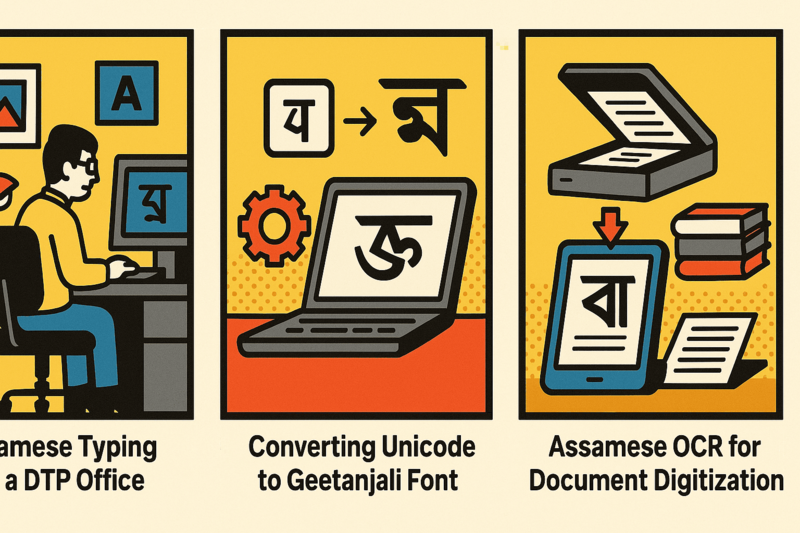
Rupantarak provides bidirectional conversion between Unicode and Geetanjali (and the other major legacy systems), with a conjunct-aware mapping engine that handles the full Juktakkhor repertoire. The guide to this conversion workflow is available in the Geetanjali to Unicode tutorial.
For organizations with large legacy archives, the PageMaker to InDesign migration guide covers the full platform migration path. For digitizing printed Assamese content into Unicode, PrintMint Pro’s built-in OCR provides Assamese-specific recognition that outputs Unicode directly — bypassing the need for encoding conversion on the input side.
The practical implication for publishers and institutions: any digitization or archival project involving Assamese material must begin with an encoding audit. Assuming all legacy Assamese files use the same encoding system is a systematic error that produces corrupt output.
What Remains
As of 2026, the Assamese encoding landscape has bifurcated cleanly:
- Digital/web: Unicode exclusively, using fonts like Noto Serif Bengali, Kalpurush, or Solaimanlipi
- Print/legacy DTP: Geetanjali primarily, with Ramdhenu and Bikash still in use at specific publishing houses
The bridge between these worlds — Unicode → Geetanjali for press output, Geetanjali → Unicode for digitization — is the active challenge for anyone working with Assamese content across the encoding divide. See the complete Assamese DTP software guide for a practical look at the tools available for each stage of this workflow, and the Assamese newspaper DTP workflow for a real-world account of how this dual-encoding reality operates in a live newsroom.
Frequently Asked Questions
When was Geetanjali encoding developed?
Geetanjali was developed in the early-to-mid 1990s as personal computers became accessible to Assamese publishing houses. It was among the first widely distributed Assamese DTP fonts for the PC platform, alongside Ramdhenu and several regional competitors. There is no single published development date — Geetanjali, like most legacy Indian language fonts of the era, was an informal commercial product.
Why didn't Assamese font developers coordinate on a single encoding standard?
In the early 1990s, there was no national or international standard for Indian language encoding on personal computers. ISCII (Indian Script Code for Information Interchange) existed but was not widely adopted in commercial DTP software. Each font developer created their own keyboard mapping to maximize typist speed for their target customer. The result was competing proprietary systems with incompatible encodings.
Is Geetanjali still being sold or maintained?
Geetanjali as a font encoding system is a legacy technology. The font files themselves are widely distributed and still in active use in printing houses. There is no active development organization maintaining the encoding specification — the de facto specification is the existing font file itself. Conversion tools like Rupantarak maintain the mapping tables for backward compatibility.
How do I identify which encoding an old Assamese document uses?
Open the document in a text editor (not a DTP application) and look at the raw characters. Geetanjali text will display as English letters and punctuation. If it looks like ASCII but the printed output shows Assamese, it is a legacy encoding. To distinguish Geetanjali from Ramdhenu or Bikash, examine which keyboard characters represent common vowel matras — the mapping for the i-matra (ি) differs between systems.