How Assamese Newspapers Actually Do DTP: The Dual-Encoding Reality
Inside the real DTP workflow at Assamese daily newspapers — how reporters, editors, and DTP operators navigate the Unicode–Geetanjali divide using WhatsApp, PageMaker 6.5, and Rupantarak to get the paper to press.
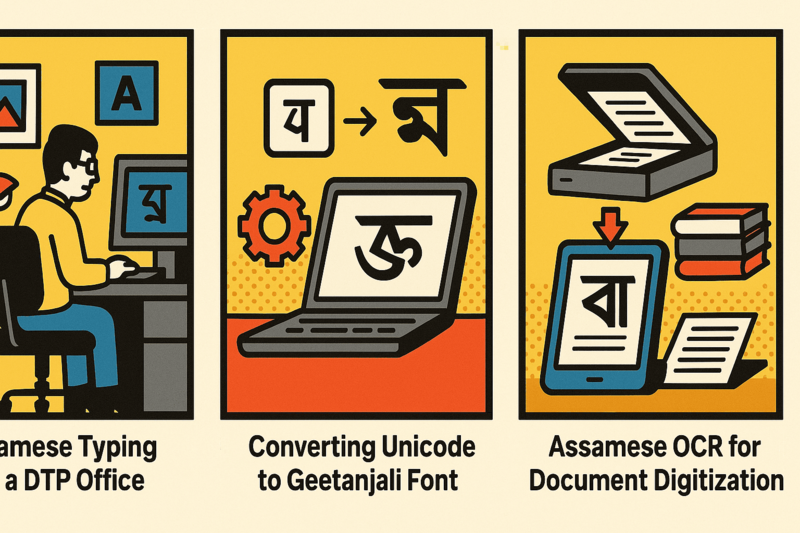
The Workflow That Nobody Documents
Every Assamese DTP professional knows how this works in practice. The formal workflow that software vendors describe and the actual workflow inside a working newsroom are two different things. Here is what actually happens at a mid-sized Assamese daily in 2026.
Stage 1: Reporters Type in Unicode on Phones
Reporters in the field type stories on Android smartphones. The Assamese keyboard on Android (whether Gboard with Assamese layout, Jahnabi Pro, or a regional input method) produces Unicode text — characters in the U+0980–U+09FF range. This is the correct, portable, web-compatible encoding.
The story gets submitted to the editor via WhatsApp. This is not a workaround or an informal hack — it is the production pipeline. WhatsApp carries Unicode text faithfully. The editor reads it, edits it directly in WhatsApp or copies it into a text editor, and marks it for layout.
Stage 2: The Encoding Barrier at the DTP Desk
The DTP operator works on a Windows PC running PageMaker 6.5. The PageMaker installation has Geetanjali (and often Ramdhenu, Bikash, or Pragjyotish) installed as the primary Assamese font. Every existing page template, every past issue’s masthead and column layout, every advertisement specification — all of it is in Geetanjali encoding.
When the editor sends the Unicode copy to the DTP desk, it cannot go directly into PageMaker. PageMaker’s Assamese text boxes are configured for Geetanjali. Pasting Unicode into them produces garbage output — the multibyte Unicode characters are interpreted as the wrong encoding, or PageMaker simply cannot process them at all.
This is the encoding barrier. It is real, it occurs every production cycle, and it must be crossed every day.
Stage 3: Rupantarak Bridges the Gap
The solution is Rupantarak, which converts Unicode Assamese text to Geetanjali encoding (and vice versa) with full awareness of conjunct character mappings.
The practical workflow at the DTP desk:
Step-by-step conversion and layout pipeline:
- Receive — DTP operator receives Unicode text (WhatsApp copy-paste, email, or shared document)
- Open Rupantarak — Launch the converter application
- Paste & Convert — Paste the Unicode text, select Unicode → Geetanjali conversion, click convert
- Copy Geetanjali output — The converted Geetanjali-encoded text is copied to clipboard
- Import into PageMaker — Paste into the appropriate PageMaker text box with Geetanjali font active
- Set font — Confirm font is set to Geetanjali (the text already renders correctly since encoding matches)
- Layout — Adjust column widths, handle hyphenation, fit to page
- First proof — Print a PDF proof or physical proof for sub-editor review
- Corrections — Any corrections made in the PageMaker Geetanjali environment
- Final export — Export to press-ready PDF with Geetanjali fonts embedded
For the web edition, the Unicode original (pre-conversion) is used directly — published to the newspaper’s CMS without any Geetanjali conversion step.
For reporters typing content on phones or computers, the Jahnabi Pro Keyboard provides professional Unicode Assamese input with conjunct support. For a step-by-step tutorial on the Rupantarak conversion workflow itself, see the Unicode to Geetanjali tutorial.
Why the Dual-Encoding World Persists
The obvious question: why not simply move everything to Unicode and use InDesign or a Unicode-aware DTP system?
The answer is layered and practical:
Institutional inertia of page templates. A newspaper’s page template is not just an InDesign file. It encodes years of design decisions: column widths calibrated to a specific font’s metrics, masthead spacing tuned for Geetanjali’s em-width, classified ad grids built around Geetanjali character density. These cannot be automatically ported — they must be rebuilt by hand.
Operator training costs. DTP operators who have used PageMaker 6.5 with Geetanjali for 15 years know every keyboard shortcut, every workaround. InDesign is a different application. Retraining an entire desk during a live production operation is a significant organizational risk.
Historical archive compatibility. Decades of past issues exist as PageMaker files with Geetanjali encoding. For reprints, corrections, and legal reference, the paper must be able to open and edit these files. Migrating the entire archive to Unicode requires systematic conversion of every archived file — a project measured in months.
Press compatibility. Some printing presses and prepress workflows are calibrated to accept PDFs from PageMaker with embedded Geetanjali fonts. Changing the output format requires renegotiation with the press supplier.
The Web Edition Divergence
Newspapers with web editions maintain two parallel text streams. The Unicode original goes to the CMS (WordPress or custom). The Geetanjali-converted version goes to the print pipeline. This divergence creates an editorial problem: any correction made at the DTP layout stage (in Geetanjali) must be manually backported to the Unicode web version, and vice versa.
Forward-looking newspapers are addressing this by making the Unicode version canonical — all corrections happen upstream in Unicode, and the Geetanjali conversion is the final one-way step before press export. See the Assamese DTP software guide for a full comparison of DTP approaches.
What Dainik Janambhumi and Dainik Asom Represent
These newspapers represent the two dominant models in Assamese daily publishing. Dainik Janambhumi has been print-first throughout its history, with Geetanjali deeply embedded in its production pipeline. Dainik Asom has made more aggressive moves toward digital-first workflow, maintaining Geetanjali only where press compatibility demands it.
The intermediate solution adopted by both — and by most Assamese newspapers — is precisely the Rupantarak bridge: Unicode as the working language for all editorial and digital operations, Geetanjali as the final encoding for press output. It is an inelegant but functional architecture, and it will remain the dominant model until the economics of full PageMaker-to-InDesign migration become favorable for mid-sized publishers.
For publishers considering that migration, see the PageMaker to InDesign migration guide for a practical timeline and checklist. For the historical context on why Geetanjali became the dominant Assamese newspaper standard in the first place, read the history of Assamese font encoding. For newspapers that also need to digitize legacy printed archives, PrintMint Pro’s built-in OCR can extract Unicode text from scanned pages — see the Assamese newspaper OCR guide for the newspaper-specific workflow.
Frequently Asked Questions
Why do Assamese newspapers still use PageMaker 6.5?
PageMaker 6.5 became the standard in Assamese newspaper production in the late 1990s when Geetanjali fonts were the dominant encoding. Switching to InDesign requires rebuilding all templates, retraining operators, and converting the font pipeline — a significant cost for mid-sized papers. Many newspapers maintain PageMaker for print production while adopting Unicode for their web editions.
How do Assamese newspaper reporters submit copy to the DTP desk?
Most reporters now type on smartphones using Unicode Assamese keyboards (Gboard, Jahnabi Pro, or similar) and submit via WhatsApp. Some use email with Unicode text attachments. The editorial desk edits in Unicode. The DTP team then converts to Geetanjali using Rupantarak before importing into PageMaker.
What happens when Unicode text is pasted directly into PageMaker with Geetanjali font selected?
PageMaker with Geetanjali selected cannot interpret Unicode code points. The Unicode Assamese characters — stored as multibyte UTF-8 — are either displayed as question marks, boxes, or garbled ASCII depending on the system. Direct paste from Unicode into a Geetanjali PageMaker document always produces unusable output. Conversion before import is mandatory.
How fast is Rupantarak at converting newspaper copy?
Rupantarak converts approximately 2000 pages in 42 seconds in batch mode. For a typical daily newspaper volume of 10–20 pages of editorial content, conversion is near-instantaneous — under 2 seconds. The bottleneck in the DTP pipeline is not conversion speed but layout and proofreading time.